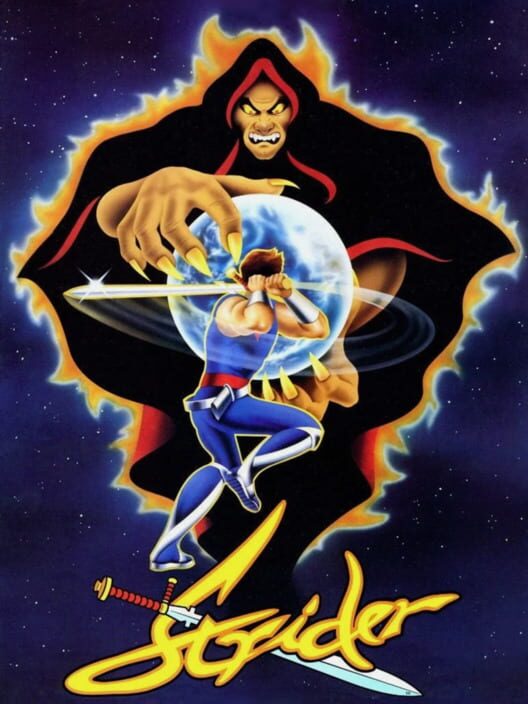
Strider (1989)
Amiga, Amstrad CPC, Arcade, Atari ST/STE, Commodore C64/128/MAX, DOS, PlayStation, Sega Master System/Mark III, Sega Mega Drive/Genesis, Sharp X68000, Wii, Wii U, ZX Spectrum
My Save State is where you keep a diary of the games you play.
You can't play Strider here, but you can log it, rate it, and see what other players think.
Sign up free Already a member? Sign inNumerous power-ups can be obtained from item boxes carried by certain enemies. These includes an extension to Hiryu's attack range that lasts for one hundred slashes, two types of health aids (represented by the kanji used to write Hiryu's name: 飛 and 飛竜), a max health extension (represented by the kanji 竜, the second character in Hiryu's name), an extra life, and a power-up that not only makes Hiryu invulnerable to attack but also increases his own attack abilities via shadow images of himself for 15 seconds.[3] Hiryu can also summon robotic companions known collectively as "options" that help him fight enemies. These consist of up to two mushroom-like droids, a saber-toothed tiger and a hawk, known individually as Option A, B and C respectively.
The game has five stages: the Kazakh Soviet Socialist Republic (called "St. Petersburg" during the arcade game's attract sequence), the Siberian Wilderness, the Aerial Battleship Balrog (געלראב), the Amazonian Jungle, and the Grandmaster's lair itself, the Third Moon. Each of the stages is divided into a number of smaller sections, each with their own time limit and checkpoint location. The player has a three-point health gauge (which can be increased to five points with the health extensions. Hiryu will lose a life when either his health gauge is fully depleted, by moving him off the screen entirely (like falling into a bottomless pit) or when the game's timer reaches zero. It's Game Over when all of Hiryu's lives are lost, but the player can be given the opportunity to continue. Read more
Details
Release dates
- Mar 01, 1989 (Japan) Arcade
- 1989 (Europe) ZX Spectrum, DOS, Commodore C64/128/MAX, Amiga, Atari ST/STE, Amstrad CPC
- Sep 29, 1990 (Japan) Sega Mega Drive/Genesis
- 1991 (Brazil) Sega Mega Drive/Genesis
- 1991 (Europe) Sega Master System/Mark III
- Nov 27, 1992 (Japan) Sharp X68000
- Jan 01, 2000 (Brazil) Sega Mega Drive/Genesis
- Jul 26, 2000 (North America) PlayStation
- Feb 16, 2012 Wii
- Nov 18, 2012 Wii U
Related
Bundled in
- Capcom Coin-Op Classics Series 1 (Dec 1999) · PC
- Capcom Classics Collection Remixed (Apr 2006) · PSP
- Capcom Classics Collection Vol. 2 (Nov 2006) · PS2, XBOX
- Mega Drive Mini (Sep 2019) · Plug & Play
- Sega Genesis Mini (Sep 2019) · Plug & Play
- Capcom Home Arcade (Nov 2019) · Plug & Play
- The Capcom Collection (Dec 2022) · Evercade
- Super Pocket: Capcom Edition (Nov 2023) · Evercade, Handheld
- Evercade Alpha Mega Man Bartop Arcade (Nov 2024) · Evercade, Plug & Play
Ports
- Strider (Jul 1989) · NES
- Strider (Dec 1990) · Handheld
- Strider Hiryuu (Sep 1994) · Turbografx-16/PC Engine CD